The Wilderness Years
After Don Revie�s departure in 1974, following his successful tenure that included winning the First Division title in 1974, Leeds United faced a significant transition. Revie�s successor, Brian Clough, was appointed but had a short and troubled stint. Clough�s tenure was marked by discord and poor results, leading to his departure just 44 days later. Jimmy Armfield was then appointed as manager, guiding the team through a period of instability. In 1975, Leeds United reached the European Cup final under the management of Jimmy Armfield. The match, held at the Parc des Princes in Paris, ended in a controversial 2-0 defeat to Bayern Munich. The referee�s decisions during the game were highly disputed, and the loss was a bitter blow following the club's domestic success under Revie.
The Post-Revie Rebuild (1975�1980)
After Don Revie�s departure in 1974, Leeds entered the management era of Jimmy Armfield. Though Armfield led the Whites to a respectable 5th-place finish in 1975�76, form dipped in subsequent seasons with 10th in 1976�77 and 9th in 1977�78, failing to rekindle the momentum from the Revie vintage. Despite the emergence of future leader Billy Bremner and the introduction of youth prospects, the squad lacked the steel to compete at the top. Ultimately, Armfield departed, having struggled to maintain the club's identity from the previous era.
Jock Stein�s brief 44-day tenure in 1978 looked like a potential renaissance�only to collapse when he accepted Scotland's managerial role. Jimmy Adamson took over in October 1978 and briefly raised hopes of a return to form, guiding Leeds to a League Cup semi-final and a strong 5th-place finish in the 1978�79 First Division. Yet his momentum faltered in 1979�80 as significant player sales undermined consistency, culminating in an 11th-place finish and growing disquiet among fans.
Adamson resigned in October 1980 after a difficult few months. Leeds earned a steady 9th place under his replacement, former striker Allan Clarke, who stabilised the club but lacked the firepower to launch them back to greatness. Over five years, Leeds had drifted from European contenders to well-meaning mid-table dwellers in the First Division�highlighting diminishing ambitions and warped expectations.
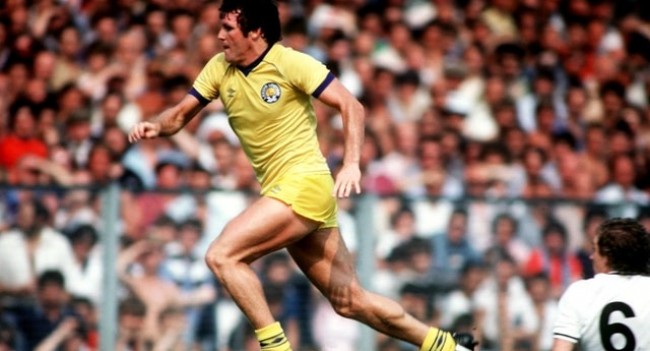
Managerial Instability (1980�1988)
Allan Clarke�s appointment did steady the ship. In 1980�81, he secured a 9th-place finish, and early signs suggested Leeds might rebuild their identity . However, Clarke�s side struggled defensively, and after a poor start in 1981�82�including a humiliating 5�1 defeat to Swansea�Leeds were relegated on the final day shortly after he was dismissed.
The club turned to legend Eddie Gray, who became player-manager in 1982. Gray led with flair, guiding Leeds to mid-table finishes in the Second Division (8th and 7th) over his first two seasons. Financial hardship and boardroom turmoil continued, and by October 1985, Gray was replaced by club legend Billy Bremner. Bremner heavily reshaped the squad by combining veteran experience with a few young hopefuls�but central funding remained limited. Under his management, Leeds reached the 1987 Second Division play-off final (losing to Charlton after a replay), and also made an FA Cup semi-final, but fell short of promotion.
Despite steady 40%+ win rates, Bremner clashed with the board over transfer support and was dismissed in September 1988. Leeds, still mired in the Second Division, showed glimpses of resilience and identity, but lacked the strategic vision and coherent leadership to return to former heights.

A Forsaken Decade
From 1975 to 1988, Elland Road witnessed major turbulence: top-tier decline, managerial turnover, and erratic boardroom policies. While personalities like Armfield, Clarke, Gray, and Bremner instilled moments of hope, a lack of long-term financial investment and strategic clarity held Leeds back. The once-proud club, so dominant under Revie, faced an identity crisis�struggling to adapt to modern football�s demands. As the stadium�s echo faded into mid-table obscurity, Leeds prepared for a new chapter under Howard Wilkinson, whose arrival in 1988 laid the groundwork for the revival yet to come.
For a comprehensive history of this period see �1975-82 - The Downward Spiral� on OzWhite's History of Leeds United
| Period Summary | Division | Pos (Pts) | FA Cup |
Lg Cup |
Europe |
Other |
| 1975-1976 Details | Division One | 5 (51) | R4 |
R3 |
- |
- |
| 1976-1977 Details | Division One | 10 (42) | SF |
R2 |
- |
- |
| 1977-1978 Details | Division One | 9 (46) | R3 |
SF |
- |
- |
| 1978-1979 Details | Division One | 5 (50) | R4 |
SF |
- |
- |
| 1979-1980 Details | Division One | 11 (40) | R3 |
R2 |
UC (R2) |
- |
| 1980-1981 Details | Division One | 9 (44) | R3 |
R2 |
- |
- |
| 1981-1982 Details | Division One | 20 (42) | R4 |
R2 |
- |
- |
| 1982-1983 Details | Division Two | 8 (60) | R4 |
R3 |
- |
- |
| 1983-1984 Details | Division Two | 10 (60) | R3 |
R3 |
- |
- |
| 1984-1985 Details | Division Two | 7 (69) | R3 |
R3 |
- |
- |
| 1985-1986 Details | Division Two | 14 (53) | R3 |
R3 |
- |
MC (Grp) |
| 1986-1987 Details | Division Two | 4 (68) | SF |
R2 |
- |
MC (R1) |
| 1987-1988 Details | Division Two | 7 (69) | R3 |
R3 |
- |
MC (R2) |
 |
 |