


Over the years, shirt sponsorship has been a welcomed practice on the football field. Like any other sponsorship, shirt sponsorship significantly benefits the football teams. Following are some of the benefits of shirt sponsorships:
- Sponsorship gives the funding as well as the promotion for a colossal event to attain its maximum potential;
- Sports and athletes’ promoters may pay more attention to gearing up and training for the big game than tracking donations;
- Big-name sponsorship may create attention for a game or event, bringing in a larger audience;
- The increased viewership or attendance via a sponsorship partner may boost large sales and other sports revenues.
The history of Leeds United shirt sponsors
Leeds United’s first sponsors were the RF Winders (RFW), a firm from Pusey, and lasted only twelve months. After this, the football club’s sponsorship ran through three various patrons; WGK, Systime, and Lion cabinets. Since then, Leeds United has had several shirt sponsors over the years.
1986 – 1988: Burton Group
Burton was the Leeds United shirt sponsor between 1986 and 1988. The agreement between the Borton Group, a local clothier’s company, and Leeds United was reached in 1986. During this time, the future chairman of Leeds United, Peter Ridsdale, was the managing director of Top Chain, part of Burton. He was the power behind the association and joined Leeds United’s board in 1987. The two organizations had signed a five-year partnership.
1989- 1991: Top Man
In 1989, Burton insisted that Leeds United uses their Top Man brand for the remaining two years of their partnership. As a result, the Top Man logo was introduced in 1989/90 on a redesigned strip and a round and bottom-up blue collar. At the same time, gold and blue trimmings were added to socks and shirts. The club captured the fourth position in the top division and the Second Division title during the same period. The away sponsored kit sported a busy pattern of amber and yellow triangles.
1991 - 1992: Yorkshire Evening Post
During this period, Leeds United maintained the same kits they had from Burton, although there was a change of the shirt sponsor. The Burton deal ended, and the club signed a multi-million deal with Admiral Sportswear. However, the agreement could not commence until 1992. As a result, the club had to look for an alternative and established a stop-gap agreement with the Yorkshire Evening Post to bridge the 12 months before Admiral commenced.

1992 – 1993: Admiral Sportswear
The Admiral Sportswear company commenced its Leeds United Shirts sponsorship in 1992. The new kit was only slightly different from the previous one. The new design did integrate a new V-neck look. However, the change strip went through more radical changes. The initial pick was principally blue with a hideous yellow-flecked pattern on its shoulder. This was Leeds United’s first shift from yellow for a period. However, a variant of yellow and blue flecking was introduced soon due to the potential for color clashes. The Admiral gear adorned the team as United resumed its position in European competition as well as secured the Charity Shield.
1993 – 1996: Thistle Hotels
The agreement between Leeds United and Admiral Sportswear was meant to last 5 years. Still, within 12 months of the commencement of the deal, there was a fallout, and the organizations parted ways following a legal dispute. The club then developed a new arrangement with Thistle Hotels chain to sponsor their shirt. This saw a completely new shirt look introduced. The new shirts had gold and blue stripes but were replaced with green and dark blue striped shirts in early 1994.
During Thistle Hotels’ sponsorship, the club first adopted players’ names and squad numbering on shirts. The system was utilized for the first time during the League Cup final. This was on April 18th, 1993, when Sheffield met Arsenal. Less than a month later, the same teams again used the system when they met at Wembley for the 1993 FA Cup Final. And five days later for a replay. Squad numbers were launched as a standard in the 1993/94 Premiership season. Coincidentally, it was when Thistle Hotels chain was Leeds United’s sponsor.
1996 – 2000: Packard Bell
Leeds United’s shirt was manufactured by Puma and sponsored by Packard Bell during this period. The new kit incorporated the Packard Bell logo and a broad yellow trim. The changed kit saw the yellow and white interchanged, while for 1997 and 1998, the old blue and gold halved shirts of the 30s and 40s were revived to remarkable effect. In 1998, the Shield badge was introduced, bringing an almost European feel. A trivial change was added with a ball at the white rose's midpoint a year later. The home kit was not changed apart from an added color and the significant usage of the Puma brand on the down end of the sleeves.
2000 -2004: Strongbow
As Leeds United prepared for the 2000 UEFA Championships League debut, it joined hands with Bulmers and Nike to manufacture kits and Strongbow as their shirt sponsor. During this period, the V-neck look of the shirt was restored, and the Strongbow logo was incorporated into the shirt.

2003 – 2006: White & Mackay
In 2003, Whyte and Mackay, the whisky manufacturers, started a three-year contract with the Leeds United but was disappointed as the club slumped to a disastrous relegation in 2004. The only change to the home kit was the logo. However, a stylish dark blue kit with white and yellow pinstripes was introduced for some away games. This was among the unluckiest kits ever worn by the Leeds United club. They conceded 14 goals and only gained one point from the five games they played while wearing it. An all-yellow kit was commonly used. Other kits were also used during this period, but less often.
2006 – 2007: Bet24
In July 2006, the club announced a significant agreement with Bet24, a leading internet betting site, on its website. However, the club claimed that the agreement exceeded the usual shirt sponsorship. The partnership entailed helping Leeds United regain its international position, with all the associated merchandising and commercial opportunities.
In 2006/07, the home kit was changed with the pinstripes disappearing and blue trim heavily used in addition to the Bet24 logo. The changed strip led to the restoration of an all-yellow shirt with blue cuffs and collar.
2007 – 2008: Red Kite Holdings
After relegation, there was a protracted struggle to eject the administration in 2007. This resulted in a delay in the arrangements for a new shirt sponsor. In the pre-season win at Darlington, the club used a shirt with tape covering the name of the previous sponsor. Finally, a property company, Red Kite Holdings, was announced as the shirt sponsor. However, the red in their logo infuriated Leeds United’s fans.
2008 – 2011: Netflights.com
During the 2007/2008 period, Macron, the new Italian supplier that Leeds United had signed a deal with, delivered conventional home and third kits. However, the further away kit was an entirely new creation in deep navy and sky-blue. The kits were formally introduced in July 2008, but the launch was ruined by a dispute between Leeds United and their shirt sponsor, leading to delayed delivery.
In August of the same year, Leeds United finalized a shirt sponsorship with Netflights.com. This was a local online travel agent that included Trevor Cherry (former Leeds United captain) and Terry Fisher in their management. The sponsor came in at a time when United was facing contractual challenges with their previous sponsor. The two organizations signed a three-year shirt sponsorship agreement, with the organizations expected to drive several co-marketing opportunities.
In 2009/2010, the shirt sponsorship by Netflights.com remained in place, with the new kit utilized for the first time during the 2008/09 final League game while hosting Northampton. This unique home kit was an incredible reinterpretation of the all-white strip and a royal blue flash on the left-hand side with gold trim. The club’s tradition was also maintained with an all-yellow away kit. The kit had a royal blue side panel on both the shirt and shorts.
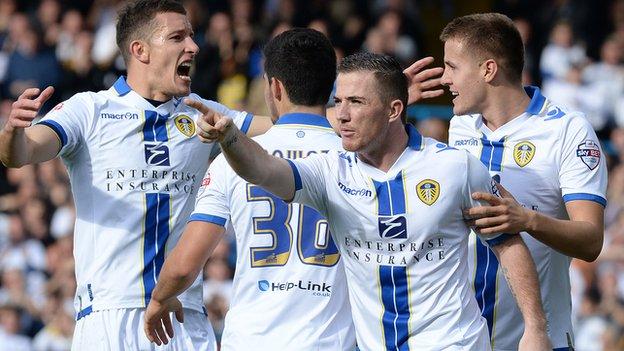
2010- 2015: Enterprise Insurance
Leeds United chose to launch its 2010/2011 kit early enough for the 2009/2010 final game as they hosted Bristol Rovers. During the same time, United confirmed their promotion to the Championship. This led to the return of their traditional all-white strip, synonymous with among the best periods in the club’s history.
Leeds United identified Enterprise as their new major sponsor. The agreement between the two organizations was for an initial one-year term. It would see all first-team training wear, playing kit, and replica kit branded with the sponsor’s logo.
On 24 April 2012, Leeds announced that Enterprise Insurance had extended its sponsorship deal for an additional two years and would continue being the main sponsor to the end of the 2013/2014 season. Enterprise Insurance prolonged its agreement as Leeds United’s sponsors on 5 September, rolling on the initial three-year contract for an additional three seasons to the end of the 2016/2017 campaign. This makes it the longest sponsorship deal in Leeds United's history.
2016 – 2020: 32Red
In 2016, Leeds United signed a shirt sponsorship deal with 32Red as the main shirt sponsor. The two agreed to a three-year contract. Other clubs were creating arrangements with this gaming firm. These included Middlesbrough, Derby, Blackburn, Rangers, and Preston. The 32Red logo was in blue for 2016/2017. However, it was switched to gold in 2017/2018. This led to some fans accusing United of looking for a cheaper form of Swansea’s style, probably influenced by Garry Monk.
2020 – 2022: SBOTOP
During this period, Leeds was promoted back to the Premier League. This brought about tremendous opportunities and attracted several potential sponsors. SBOTOP, a global sports betting company, became the main shirt sponsor. The multi-year agreement represented one of the biggest commercial deals in Leeds’ history.
Conclusion
There you have it! This is the brief history of Leeds United shirt sponsors. As you may have noticed, gaming companies are mostly this great club’s shirt sponsors. Gaming companies also help us at an individual level. For instance, you can play on one of the best Ethereum casinos and earn. All the best!